
660A POWERFIT Panel Source to ITT Powerlock Line Drain: Interconnection Temperature-Rise Test
Temperature-rise testing of a KUPO POWERFIT 750A Panel Source (PFPS-1BN-T7) mated with an ITT Powerlock 660A Line Drain (NLDFT-1-BN-L-C240-M40B). The assembly carried 664A for 3 hours, with 400 mm² cable on the POWERFIT side and 500 MCM (approximately 253 mm²) cable on the ITT side.
Test setup
- Test current
- 664A
- Cable cross-sections
- POWERFIT: 400 mm² / ITT: 500 MCM (≈253 mm²)
- Ambient temperature
- 21.7°C
- Test duration
- 3hours
Report assessment
- Maximum recorded temperature rise
- 47.1°C
- Maximum outer-casing temperature rise
- 24.6°C
- Maximum allowable temperature
- 125°C
- Report result
- PASS
01 Measured results
Test current: 664A · Ambient: 21.7°C · Duration: 3 h
Temperature rise by measurement point
| # | Measurement point | Ambient (°C) | Measured (°C) | Rise / Δ (°C) | Load (A) |
|---|---|---|---|---|---|
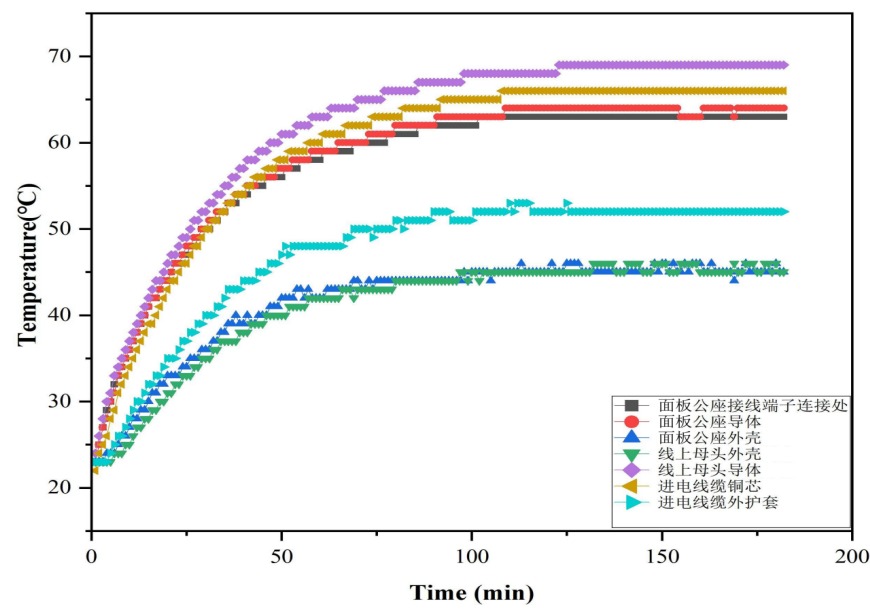
| 1 | POWERFIT Panel Source terminal-lug connection | 21.7 | 63.2 | 41.5 | 664 |
| 2 | POWERFIT Panel Source conductor | 21.7 | 63.8 | 42.1 | 664 |
| 3 | POWERFIT Panel Source outer casing | 21.7 | 46.1 | 24.4 | 664 |
| 4 | ITT Powerlock Line Drain outer casing | 21.7 | 46.3 | 24.6 | 664 |
| 5 | ITT Powerlock Line Drain conductor | 21.7 | 68.8 | 47.1 | 664 |
| 6 | Line Drain cable copper core | 21.7 | 66.0 | 44.3 | 664 |
| 7 | Line Drain cable outer jacket | 21.7 | 53.1 | 31.4 | 664 |
Temperature rise = measured temperature − ambient temperature.
02 Evaluation summary
| Criterion | Result | Assessment |
|---|---|---|
| Maximum allowable temperature | 125°C | — |
| Maximum recorded temperature rise above ambient | 47.1°C | PASS |
| Maximum recorded temperature rise of outer casing above ambient | 24.6°C | PASS |
| Temperature rise within IEC/EN 61984:2009 / BS EN 61984:2009 allowable limits | PASS | PASS |
| Temperature-rise assessment of the tested assembly | PASS | PASS |
Interconnection compatibility conclusion
KUPO POWERFIT and ITT POWERLOCK connectors were tested at 660–675A for 3 hours, with temperature rise at all critical points meeting the applicable requirements of IEC/EN 61984:2009 / BS EN 61984:2009. The results confirm the thermal stability of the tested interconnection and support safe cross-brand interoperability under the specified conditions.
03 Temperature test curve
04 Test parameters and conditions
| Parameter | Condition |
|---|---|
| Ambient temperature | 21.7°C |
| Test current | 664A |
| Test voltage | 0.380V |
| Test frequency | 50 Hz |
| Test run duration | 3 hours |
The report acceptance statement specifies continuous operation at 660–675A for 3 hours; the recorded test current is 664A.
05 Tested samples and equipment
| Item | Product part number | Configuration |
|---|---|---|
| 1 | PFPS-1BN-T7 | KUPO POWERFIT 750A Panel Source, assembled with 400 mm² cable |
| 2 | NLDFT-1-BN-L-C240-M40B | ITT Powerlock 660A Line Drain, assembled with 500 MCM (approximately 253 mm²) cable |
| Instrument | Calibration date |
|---|---|
| High-current generator | 2026-07-28 |
| Multi-channel temperature tester | 2026-07-12 |
| Clamp-on multimeter | 2026-07-12 |
06 Purpose and scope
Purpose
To evaluate the current-carrying capability and temperature-rise performance of the 660A interconnection between KUPO POWERFIT and ITT Powerlock connectors, and assess the thermal stability of the tested configuration during continuous operation under the specified current conditions.
Scope
This test evaluates the current-carrying and temperature-rise performance of interconnected KUPO POWERFIT and ITT Powerlock connectors under rated current conditions. Temperature measurements are conducted at critical locations, including connection terminals, conductors, connector housings and cable termination points, to assess the thermal performance and stability of cross-brand connector interconnections.
Acceptance statement
Under specified test conditions, the product was energized at 660–675A for 3 hours. Temperature rise at critical points was measured and verified to comply with the allowable limits specified in IEC/EN 61984:2009 / BS EN 61984:2009.
Source report
SEMT Report No. 2026JC (KP) 018A
Test date: 2026-11-04